CAUTION: This blog post has the potential to forever transform your understanding of the knowledge, power, and priesthoods of God. Do not continue reading past this point unless you are prepared to have your mind blown!
For nearly two centuries, leaders of the Church of Jesus Christ of Latter-day Saints have taught a large quantity of information regarding the omniscience, omnipotence, and priesthood authority
of God the Father and His Son Jesus Christ. Yet, studies show that there remains confusion among the Church members regarding a noteworthy doctrine: Is God still increasing in knowledge, power, and priesthoods? If so, what is the current scope of his knowledge, power, and priesthoods?
These are questions that have long troubled me as I have diligently studied the writings of the Prophets and Apostles of present and past dispensations. Finally, a couple months ago, I considered this question from mathematical perspective. When I did so, my understanding was enlarged and I saw that some supposed contradictions can actually be harmonized. Now, I am not saying that I definitively know that I am right; I am merely saying that I came to an understanding that seems to me to be consistent with the scriptures and teachings of modern-day Church leaders.
As Mormon fundamentalists repeatedly point out, there seems (at least at a first glance) to be two sets of teachings in the Church regarding the extent of God's knowledge and power and whether or not He is progressing in these attributes.
In the early Restored Church, basically all of the major church leaders (with the clear exception of the Pratt's) taught that God is still progressing; they argued that, although God is an omnipotent, omniscient Being, He is still gaining more knowledge and power with every passing day. For example, here are quotes by two of the early Presidents of the Church, Brigham Young and Wilford Woodruff:
"Brother Orson Pratt has, in theory, bounded the capacity of God. According to his theory, God can progress no further in knowledge and power; but the God that I serve is progressing eternally, and so are his children: they will increase to all eternity, if they are faithful (Brigham Young, Journal of Discourses)."
"If there was a point where man in his progression could not proceed any further, the very idea would throw a gloom over every intelligent and reflecting mind. God himself is increasing and progressing in knowledge, power, and dominion, and will do so, worlds without end. It is just so with us. We are in a probation, which is a school of experience (Wilford Woodruff, Blessings of the Saints—Condemnatory State and Conduct of the Christian World, Etc., Journal of Discourses)."
On the other hand, most of the Church leaders since the early 1900s have taught that God's omniscience and omnipotence have necessarily caused Him to become stagnant in His learning. For example, here are quotes by a past President of the Church, Joseph Fielding Smith, and a former Apostle (who was also Joseph Fielding Smith's son-in-law), Bruce R. McConkie:
"It seems very strange to me that members of the Church will hold to the doctrine, 'God increases in knowledge as time goes on.'...But how does anyone know? Where has the Lord ever revealed to us that he is lacking in knowledge? That he is still learning new truth; discovering new laws that are unknown to him? I think this kind of doctrine is very dangerous. I don’t know where the Lord has ever declared such a thing. It is not contained in any revelation that I have read. Man’s opinion unaided by the revelations of the Lord, does not make it so (Joseph Fielding Smith, Doctrines of Salvation)."
"There are those who say that God is progressing in knowledge and is learning new truths. This is false—utterly, totally, and completely. There is not one sliver of truth in it. It grows out of a wholly twisted and incorrect view of the King Follett Sermon and of what is meant by eternal progression.
"God progresses in the sense that his kingdoms increase and his dominions multiply—not in the sense that he learns new truths and discovers new laws. God is not a student. He is not a laboratory technician. He is not postulating new theories on the basis of past experiences. He has indeed graduated to that state of exaltation that consists of knowing all things and having all power.
"Will he one day learn something that will destroy the plan of salvation and turn man and the universe into an uncreated nothingness? Will he discover a better plan of salvation than the one he has already given to men in worlds without number?...If God is just dabbling with a few truths he has already chanced to learn or experimenting with a few facts he has already discovered, we have no idea as to the real end and purpose of creation (Bruce R. McConkie, Seven Deadly Heresies)."
There appears to be a contradiction. Which school of thought is true doctrine? How can we tell? Bruce R. McConkie gave us the answer. He said:
"Nonetheless, as Joseph Smith so pointedly taught, a prophet is not always a prophet, only when he is acting as such. Prophets are men and they make mistakes. Sometimes they err in doctrine. This is one of the reasons the Lord has given us the Standard Works. They become the standards and rules that govern where doctrine and philosophy are concerned. If this were not so, we would believe one thing when one man was president of the Church and another thing in the days of his successors. Truth is eternal and does not vary. Sometimes even wise and good men fall short in the accurate presentation of what is truth. Sometimes a prophet gives personal views which are not endorsed and approved by the Lord (Bruce R. McConkie, Letter to Eugene England)."
Thus, the key to identifying the truth is to carefully consider a variety of statements made by General Authorities of the past and present against the backdrop of the Holy Scriptures. Although the Standard Works and Holy Spirit definitely take priority, I would argue that math can also assist us in this process. I believe, along with such wise men of history as Pythagoras and Plato, that all truth can be expressed through mathematics.
Before we delve into the scriptures, I would like to consider the mathematical relationship between knowledge, power, and priesthoods. Power is defined as "the capacity or ability to direct or influence the behavior of others or the course of events (
Oxford Dictionary)." In order for an individual to have any amount of power, there are at least two requirements: he or she must have sufficient knowledge, and he or she must have adequate resources. Clearly one cannot perform a task when he or she doesn't know how. Furthermore, even when one does know how to accomplish a task, he or she cannot do so without adequate resources. The term "resources" encapsulates such things as time, physical materials, and authority.
Thus, power (P) is a multiplicative function of knowledge (K) and resources (R). However, if you double the amount of available resources while maintaining a constant amount of knowledge or vice versa, the amount of power will not actually double; progression in power can begin to be limited by a lack of progression in either of these two values. Since knowledge and resources can be measured according to any system of measurement we desire, we can pick a system of measurement such that the following equation becomes an approximate model (at least for a given interval):
What resources does God need to govern the Universe? We know that time is not a factor, for
Alma 40:8 teaches "all is as one day with God, and time only is measured unto men." Physical materials is not a factor either, for "even the winds and the sea obey him (Matthew 8:27)!" The only resource we really need to consider in this equation is authority over the elements.
As the LDS Gospel Topics section on priesthood explains, "priesthood is the power and authority of God. It has always existed and will continue to exist without end (see
Alma 13:7–8;
D&C 84:17–18). Through the priesthood, God created and governs the heavens and the earth. Through this power, He exalts His obedient children, bringing to pass “the immortality and eternal life of man” Therefore, Deity's fundamental resource is priesthood. The equation above for power can be rewritten as follows where "p" represents the quantity of priesthood authority that is worthily possessed:
An important thing to notice is that this equation shows that, if God progresses in priesthoods or knowledge, He progresses in power as well. With that in mind, we're ready to look at what the scriptures have to say. First, let's consider two verses from the fourth Lecture on Faith. (The Lectures on Faith are the seven doctrinal discourses that made up the doctrinal portion of the 1835 edition of the Doctrine and Covenants.)
"without the knowledge of all things, God would not be able to save any portion of his creatures; for it is by reason of the knowledge which he has of all things, from the beginning to the end, that enables him to give that understanding to his creatures, by which they are made partakers of eternal life; and if it were not for the idea existing in the minds of men, that God had all knowledge, it would be impossible for them to exercise faith in him.
"And it is not less necessary that men should have the idea of the existence of the attribute power in the Deity. For, unless God had power over all things, and was able, by his power, to control all things, and thereby deliver his creatures who put their trust in him, from the power of all beings that might seek their destruction, whether in heaven, on earth, or in hell, men could not be saved; but with the idea of the existence of this attribute, planted in the mind, men feel as though they had nothing to fear, who put their trust in God, believing that he has power to save all who come to him, to the very uttermost (Lectures on Faith 4:11-12)."
As can be seen, Joseph Smith the Prophet clearly taught that God has all knowledge and all power. This principle is explicitly taught dozens of times throughout the Standard Works. This is the grounds on which many Church leaders have argued that God is not progressing in knowledge and power. After all, how can someone gain more knowledge if they already have all knowledge? The answer to this question depends on what is meant by "
all knowledge". The word "all" is very context-specific. For example, if a child were to say that they own all of the toys (and was telling the truth,) the listener would be able to safely assume that the word "all" was used in reference to all toys that were in the room, not in reference to all toys that have ever existed or ever will exist. One instance in which the scope of God's knowledge is given context in Moses chapter one:
"And the Lord God spake unto Moses, saying: The heavens, they are many, and they cannot be numbered unto man; but they are numbered unto me, for they are mine. And as one earth shall pass away, and the heavens thereof even so shall another come; and there is no end to my works, neither to my words. For behold, this is my work and my glory—to bring to pass the immortality and eternal life of man (Moses 1:37-39)."
In this chapter, the Lord God appeared unto Moses in the mountaintop, and Moses was shown all of God's creations and was taught about the Plan of Salvation. God continually referenced His omniscience in this chapter. In the quote above, God said that all things in the heavens "are numbered unto me, for they are mine." In other words, He has intimate knowledge of all things in the Universe because they are part of His dominion. God emphasized that all things He showed unto Moses are His multiple times. We may therefore conclude that, when the scripture state that God has "all knowledge", it may mean that God has knowledge about all of His creations. If this is the case, then God will increase in knowledge (and consequently power) if He forms another creation. In the quote above, God clearly stated that He never stops making more creations. Thus, if God's knowledge is limited to His creations, He
does increase in knowledge and power.
The Doctrine and Covenants teaches us that "All truth is independent in that sphere in which God has placed it, to act for itself, as all intelligence also; otherwise there is no existence (
Doctrine and Covenants 93:30)." In this section, the term "intelligence" was used in reference to an intelligent being (We can see clearly that humans, angels, and the Savior are all intelligences in
Abraham 3, especially verse 19.) In other words, this section was teaching that all intelligent beings are given truth and the ability to act within a given "sphere". Since God is an intelligence, it is completely plausible that His knowledge and power are confined to the sphere of His creations.
This new perspective addresses Bruce R. McConkie's concern that a lack of all knowledge could lead to a failure in the Plan of Salvation. In order to be confident of His plan for His creations' exaltation, God would only need to know all things pertaining to His creations. Thus, He can still be learning new truths while maintaining complete confidence in His Great Plan of Happiness.
A final scripture that can give some additional insight into the extent of God's omnipotence is in Psalms: "[The Lord] telleth the number of the stars; he calleth them all by
their names. Great
is our Lord, and of great power: his understanding
is infinite (
Psalms 147:4-5)." This scripture invites two questions: Is God's knowledge really infinite, and, if His knowledge really is infinite, is it possible for Him to still be learning?
First, does this scripture really mean what it says; is God's knowledge really infinite? To start, we need to understand that the Old Testament was written in Hebrew, not English. Information can get lost in translation and transcription. In the Wentworth Letter, Joseph Smith wrote "
We believe the Bible to be the word of God as far as it is translated correctly (
Articles of Faith 1:8)." I can't read Hebrew, but I do know that the NIV translation for
Psalms 147:5 reads "
his understanding has no limit." This can either mean that God's knowledge is currently infinite, or it can mean that there is no limit to how much He can learn. Next, we need to understand that the Hebrew people were far more concerned with concepts than precise numerical values. For example, different accounts give different heights for Goliath the giant, but they all state that he was really tall. In fact, the Hebrews did not even have precise units of distance, area, or weight. Distance, for example, was measured in cubits. A cubit was the length of the forearm which varied from person to person. In most Hebraic literature, hyperbole was abundant. The point is, we can't assume based on this scripture alone that God's knowledge is actually infinite.
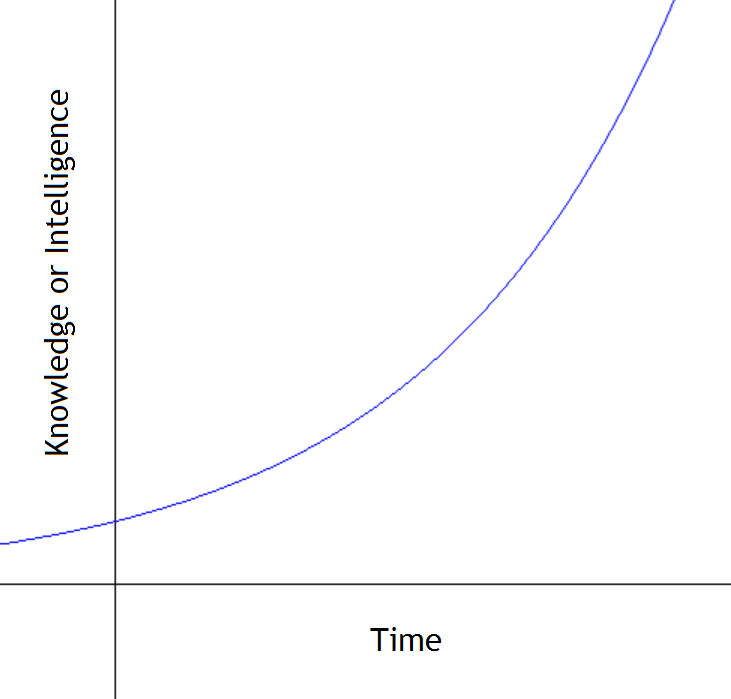
Second, if God's knowledge actually is infinite, is it possible for Him to still be learning? In my last blog post, I showed that knowledge tends to increase in an exponential fashion. The simplest exponential function is (where is K is Knowledge, t is time, and e is Euler's Number which is approximately 2.718):
This function's graph looks like this:
How fast someone is increasing in knowledge at any given time is equal to the slope of the graph at that time. As can be clearly seen, as the time goes to infinity, the amount of knowledge goes to infinity. Also, as time increases, the slope also increases. Calculus can be used to figure out the slope as time goes to infinity. It turns out that, for this function, the rate of knowledge increase is infinite when the time goes to infinity. Thus, at an infinite time, someone who already possesses infinite knowledge can be gaining more knowledge at an infinite rate. But, how can someone still be increasing in knowledge if their knowledge is already infinite? I admit, this seems a little nonsensical from a purely philosophical perspective, but I can understand this using mathematics.
Consider every number from 0 to 1. You can put any series of decimal place digits you want after a 0 and a decimal point (such as 0.32819... or 0.69275...) and you will get some number between 0 and 1. There are an infinite number of possibilities. Thus, between any two integers, there is an infinite amount of numbers. We also have the number set of all integers (...-1, 0, 1, 2, 3,...) There are an infinite number of integers between 0 and infinity. Although you have an infinite amount of numbers in a certain interval, that doesn't mean there are no numbers outside of that interval. Similarly, you can have all knowledge and still be learning.
Before I conclude, I would like to give a clear scriptural example of the Savior progressing in power. Joseph Smith even used this as an example for how the Savior progresses in his King Follett Sermon. When the Savior was resurrected, he gained the power to resurrect all mankind (See 1 Corinthians 15:20-22). After He had ascended to His Father, He appeared to His Apostles and explained to them how things were different now. During this sermon, Christ told them, "All power is given unto me in heaven and in earth (Matthew 28:18)."
Check out my other blog at https://mormonanswersforlife.blogspot.com/