Showing posts with label Holy Bible. Show all posts

Saturday, July 22, 2017

What is Chiasmus and Why Does it Matter?

In this blog post, I hope to answer three questions: What is chiasmus, how does it relate to math and religion, and why does it matter? Maybe you have never heard of chiasmus before, or maybe you know all about it. Regardless, you can likely gain new knowledge and insights by reading this blog post.

When you were in grade school, you likely learned how to write a one page essay. You were probably taught that your first paragraph should present your paper's main idea. You probably learned that one of the sentences in your first paragraph should be your thesis statement, and that it should clearly state your paper's primary arguments. The following three or so paragraphs should give reasons why your thesis statement is true. Finally, your last paragraph should pull the rest of your paper together to convince the reader of your arguments.

Now imagine that you have to start going back to grade school (kind of like what happened in the movie "Seventeen Again".) However, imagine that this time your writing class is very, very different. Envision you are sitting at a desk, pencil in hand, and you are being instructed by your teacher that you are going to spend class today writing a one page essay. You think that this will be easy; you are thinking, "I already know how to write a one page essay! Why do I have to be here again! This is torture!" However, you are about to be surprised. Your teacher is now telling you that you should always start a one-page essay by writing down the main point (or thesis statement) in the center of the page. "Now," she says, "you need to make a list of at least a couple points that support or build upon your main idea. We will call each point in the list you make an 'element'. Once you have a list of elements, you will need to use them in your essay one at a time. For each element, put part of your point just above what you have written so far in the middle of the page and part of your point just below what you have written so far. Once you have used all of the elements, your essay is done." You are extremely confused. You blurt out, "Excuse me teacher, this is not how to write a proper one page essay." With a smile on her face, she calmly replies, "That may not be how people normally write one-page essays nowadays, but what you learned today is how people wrote back in ancient Israel." All you can think is, "I just don't get it! Why would anyone write a paper that way! That is just plain weird!"


I hope that theoretical example helped you to understand just how different writing was in ancient Israel from how it is in western civilizations today. The writing style you imagined being taught is called 'chiasmus' and was thought of by the Hebrews (Hebrews is another way of saying ancient Israelites) as a beautiful form of poetry. (If you are still a little confused about what chiasmus is, don't worry. I'll explain it more in the next paragraph.) If you were to read a book written by an ancient Israelite, you could reasonably expect to find chiasmus in it. Likewise, if you read a book that contained strong chiasmus in it, you could reasonably assume that it was influenced by a Hebrew. One well-known book that was written by ancient Israelites is the Holy Bible. The Bible is packed full of plenty of chiasmus.

Basically, chiasmus is a literary style in which a list of elements (or points) are written down and then repeated in reverse order. This makes it so that you end up with an ABCCBA type pattern. The word 'chiasmus' was derived from the name of the Greek letter '𝞆' (commonly transliterated into English as 'chi'). This is because simple chiasmus can be illustrated with an 'X' (see the example below).


Do you see how, in the example above, the order of 'first' and 'last' is reversed? That is what makes it a chiasmus. Simple chiasmus can even be found in western literature. For example, President John F. Kennedy said the following:


Even though writing from much of the world contains simple, one or two sentence long chiasmus, chiasmus that fill entire blocks of text are unique to ancient Israel (and the surrounding countries).


The Bible, which was written by ancient Israelites, contains extended (long) chiasmus. For example, the following chiasmus is found in the Bible:

a There died on the earth
ball birds,
ccattle,
dbeasts and creeping things,
eman;
fall life
gdied
gand was destroyed.
fEvery living thing
eboth man,
dcreeping things,
ccattle,
bbirds,
awere destroyed from the earth.
- Genesis 7:21-23 (when translated literally from the Hebrew)

Notice that the first 'a' matches up with the other 'a', the first 'b' matches up with the other 'b', etc. Some chiasmus are the length of an entire chapter. A few are even longer than that.

So why does this even matter? How will knowing about chiasmus affect your life? There are two fundamental reasons: First, the Book of Mormon is either a book of scripture from God that will bless your life more than any other book and set you on the path towards exaltation, or it is a complete and utter fraud that will set you on the path towards Hell. Either way, it is extremely important to find out if the Book of Mormon is true. Is it a book written by Joseph Smith and/or other early LDS Church leaders, or is it exactly what it claims to be: a book of scripture written by prophets of a group of ancient Israelites who were led by God out of Jerusalem and to the Americas? A good test of this is whether or not there is intentional chiasmus in the Book of Mormon.

At the time the Book of Mormon was published, almost nobody in America knew about chiasmus. After extensive research, scholars have concluded that, at the time, there was only one book in the U.S. that even mentioned chiasmus. (See footnote 1.) Moreover, the section on chiasmus was only a short excerpt in the middle of this long book. To further complicate things, this book was kept in Philadelphia, Pennsylvania while Joseph Smith lived in Palmyra, New York. Remember, cars and airplanes didn't exist as a mode of transportation back then. It is EXTREMELY unlikely that Joseph Smith (or any of the other early Church leaders) could have known about chiasmus before the Book of Mormon's publication.

Thus, if the Book of Mormon contains intentional chiasmus, then the Book of Mormon is not a fraud. Rather, it is the word of God! It is a book that will change your life if you apply yourself to a daily study of its pages and ask God in earnest prayer each day what He wants you to learn from it.

There is a second reason why knowing about chiasmus matters. The center of a chiasmus is called the 'chiastic turning point'. The chiastic turning point is usually the main idea that the author is trying to convey. It is comparable to a thesis statement. All of the other elements are meant to build upon and explain the chiastic turning point. So, if you know that a section in the Book of Mormon or Bible is a chiasmus, you can first look and see what the main idea that the author was trying to convey is by looking at the chiastic turning point. Then, you can see how the other elements are meant to build upon and explain the chiastic turning point. This will allow you to understand the passage of scripture better, and it will allow you to gain new spiritual insights. It has definitely done that for me.

Let me show you an example. Alma 36 is an entire chapter long chiasmus. In Alma 36, Alma the younger is telling his son Helaman about his conversion story before he gives Helaman the Nephite records. For the first half of the chapter, Alma tells all about his wickedness and the negative consequences that came from his actions before his conversion. In the second half of the chapter, Alma tells all about his righteousness and the blessings that followed after his conversion. The chiastic turning point is the point at which he was converted. If you look, you will see that it was when he remembered the words of his father about Jesus Christ, the Son of God, and cried unto Christ for mercy that he was converted. At the moment that he yielded his heart unto Christ, everything turned from bad to good. There are profound lessons to be learned from this. I know of no passage of scripture that provides a stronger testimony of Christ's saving grace than this beautiful chiasmus does.

a My son, give ear to my words (Alma 36:1)
b Keep the commandments [and] ye shall prosper in the land (Alma 36:1)
c Captivity of our fathers—bondage (Alma 36:2)
d Surely God did deliver them (Alma 36:2)
e Trust in God (Alma 36:3)
f Support in trials, trouble, and afflictions (Alma 36:3)
g I know this not of myself but of God (Alma 36:4)
h Born of God (Alma 36:5)
i Seek no more to destroy the church of God (Alma 36:9)
j Fell to the earth (Alma 36:10)
k Limbs paralyzed (Alma 36:10)
l The agony of conversion (Alma 36:11–16) destroyed, torment, harrowed up, racked, the pains of hell, inexpressible horror, banished and extinct, the pains of a damned soul
mI remember … the coming of one Jesus Christ, a Son of God, to atone for the sins of the world
mI cried within my heart: O Jesus, thou Son of God, have mercy on me (Alma 36:17–18)
l The joy of conversion (Alma 36:19–22) no more pain, what joy, marvelous light, exquisite, nothing as sweet, singing and praising God, longing to be with God
kLimbs received their strength again (Alma 36:23)
j Stood upon my feet (Alma 36:23)
i Labored without ceasing to bring souls unto repentance (Alma 36:24)
h Many have been born of God (Alma 36:26)
g Knowledge is of God (Alma 36:26)
f Supported under trials and troubles, yea afflictions (Alma 36:27)
e Trust in him (Alma 36:27)
d He will still deliver me (Alma 36:27)
c Egypt—captivity (Alma 36:28–29)
b Keep the commandments and ye shall prosper in the land (Alma 36:30)
a This according to his word (Alma 36:30)

And now we get to math. Some people have claimed in the past that the chiasmus in the Book of Mormon occurred by chance and were not intentional. This was an important question to settle, for the authenticity of the Book of Mormon was at stake. Two physics professors at Utah State University, named Boyd and Farrell Edwards, made a statistics program that was capable of calculating a rigorous lower bound on the statistical likelihood that the chiasmus in the Book of Mormon were intentional. For Alma 36, they found that there is less than a one in 150,000 chance that the chiastic structure could have occurred accidentally. In science, if something is shown to have greater than a 95% chance of being the case, it is assumed to be true until evidence comes along that suggests otherwise. For Alma 36, we can be more than 99.999% sure that it was an intentional chiasmus. So, it is almost indisputable that it was intentional. There are many other strong chiasmus in the Book of Mormon.

Thanks to math, it has been confirmed that the Book of Mormon is exactly what it claims to be: It is the word of God! It is a book of Divine revelation! We should heed its every word! We should value its teachings over the teachings of man! However, even though the math tells a clear story, we should not stop there in gaining a testimony of the Book of Mormon. I invite you to read the Book of Mormon, ponder in your heart the message it contains, and pray to Heavenly Father in the name of Jesus Christ to ask Him if the Book of Mormon is the word of God. If you do so, the Holy Spirit will confirm its truthfulness to your heart. Numbers on a page can change your beliefs. However, a conversion by the power of the Holy Ghost is far more likely to change your actions and character. Together, learning by study and learning by faith can provide an unshakable testimony of the truth that will not be affected by the very jaws of Hell.

I invite you to ponder and pray about who you can share this message with. Then, follow through on the inspiration you receive. Every person around you is a child of our Loving Father in Heaven. He or she has Divine potential inside of him or her. By sharing this glorious message of truth with him or her, you are providing an opportunity for him or her to latch ahold of that potential and bloom into that beautiful son or daughter of God he or she is capable of becoming. I testify of this message in the name of Jesus Christ. Amen.

Footnote 1: In case you are wondering, the only book in the U.S. that mentioned chiasmus at the time the Book of Mormon was published was "Introduction to the Critical Study and Knowledge of the Holy Scriptures" by Thomas Hartwell Horne. It was first published in 1825.

Saturday, December 24, 2016

The Math of Christ's Birth Part 3: The Wise Men and Star

Each Christmas, millions of people around the world read the Bible story of Christ's birth from the Gospels of St. Matthew and St. Luke. The Gospel of Matthew teaches:
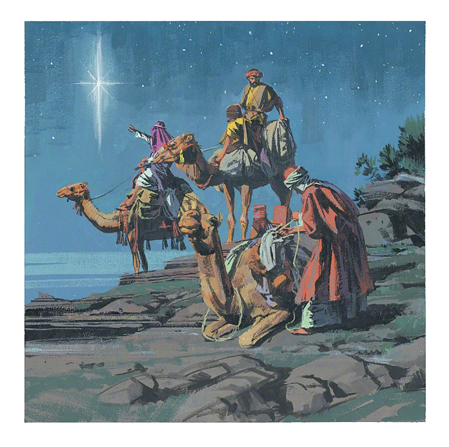
"Now when Jesus was born in Bethlehem of Judæa in the days of Herod the king, behold, there came wise men from the east to Jerusalem, Saying, Where is he that is born King of the Jews? for we have seen his star in the east, and are come to worship him (KJV Holy Bible, Matthew 2:1-2)."
Who were these "wise men from the east"? How did the wise men know that the appearance of a new star signified the birth of the Jewish Messiah? What can astronomy and mathematics teach us about the new star that appeared? These are questions that will be discussed in this blog post.
 
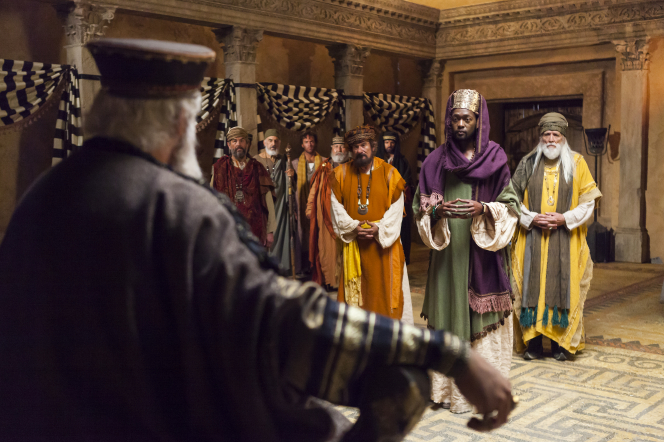
Although we do not possess the New Testament in its original form, the earliest New Testament manuscripts we have are written in Koine Greek (See Note 1 to learn more). Where the King James Version of the Bible says "wise men", these Greek transcripts say "magi". The magi were royal priests and scholars in Persia, Babylon, India, and Arabia. The magi were literate and studied religious texts. They also had great knowledge of astronomy.
 
In the Old Testament, we read about Jerusalem being conquered by Babylon shortly after 600 B.C. (The Book of Mormon teaches that 600 BC is when Lehi and his family left Jerusalem after Lehi had received a vision that Jerusalem would be destroyed due to its wickedness.) The Jews were taken captive into Babylon. Daniel, a righteous Jew, became a personal adviser to the Babylonian King Nebuchadnezzar. When the Persians conquered the Babylonians, they freed the Jews and gave them the option to return to Jerusalem and rebuild their temple. A righteous Jew named Esther became a Persian queen. Due to this history, both the Babylonian and Persian magi were well acquainted with Jewish sacred literature. Although most of the magi were Zoroastrians, some of the magi likely were Jewish.
 
When the wise men arrived in Jerusalem and told Herod that they had seen the Messiah's star and were come to worship Him, Herod "was troubled, and all Jerusalem with him (KJV Holy Bible, Matthew 2:3)." The fact that all of Jerusalem was troubled suggests that the Jews did not recognize the new star as a sign of their Messiah's birth. This can be partially explained by the wicked condition of most of the Jews at the time. However, there were some Jews who were still righteous. Why didn't the righteous Jews recognize the new star as a sign of their Messiah's birth? The only Old Testament prophecy regarding a new star appearing at the time of the Messiah's birth is the following: 
"I shall see him, but not now: I shall behold him, but not nigh: there shall come a Star out of Jacob, and a Sceptre shall rise out of Israel, and shall smite the corners of Moab, and destroy all the children of Sheth (KJV Holy Bible, Numbers 24:17)."
 
As can be seen, the prophecy regarding the new star was rather vague.  Let us assume for a minute that this scripture alone could allow people to recognize the new star as a sign of Christ's birth. Most estimates of the population of Jerusalem at the time of Christ range from 15,000 to 100,000 people. Even if the population was only 15,000 and only 1 percent of the people in Jerusalem were looking for the signs of Christ's birth, 150 people should have recognized the new star as such a sign. Yet, no one did. Math makes it apparent that the Jewish scriptures alone were not enough to recognize the star as a sign of Christ's birth.

How, then, did the wise men know that the Savior had been born? LDS Apostle Bruce R. McConkie said of the wise men, "Rather, it would appear they were true prophets, righteous persons like Simeon, Anna, and the shepherds, to whom Deity revealed that the promised Messiah had been born among men (Doctrinal New Testament Commentary)." This view is consistent with mathematics.

Matthew 2:1–8, The Wise Men meet King Herod

Matthew's account of the wise men continues:
"And when [Herod] had gathered all the chief priests and scribes of the people together, he demanded of them where Christ should be born. And they said unto him, In Bethlehem of Judæa: for thus it is written by the prophet, And thou Bethlehem, in the land of Juda, art not the least among the princes of Juda: for out of thee shall come a Governor, that shall rule my people Israel. Then Herod, when he had privily called the wise men, inquired of them diligently what time the star appeared. And he sent them to Bethlehem, and said, Go and search diligently for the young child; and when ye have found him, bring me word again, that I may come and worship him also. When they had heard the king, they departed; and, lo, the star, which they saw in the east, went before them, till it came and stood over where the young child was. When they saw the star, they rejoiced with exceeding great joy. And when they were come into the house, they saw the young child with Mary his mother, and fell down, and worshipped him: and when they had opened their treasures, they presented unto him gifts; gold, and frankincense, and myrrh (KJV Holy Bible, Matthew 2:4-11)."

What was this new star that appeared to signify Christ's birth and guided the wise men to the home of Mary and Joseph? A variety of early Christian writings by such prominent church leaders and scholars as Ignatius, St. James, and Eusebius teach us that the new star was different from the other stars in the sky; the new star was indescribably bright, thereby preventing the other stars in the sky from being seen. Korean and Chinese astronomers from the time of Christ's birth also recorded an incredibly bright star appearing. We read in the Book of Mormon that, when the new star appeared, "there was no darkness in all that night, but it was as light as though it was mid-day (Book of Mormon, 3 Nephi 1:19)."

There is only one known astronomical object that can accomplish such a feat; the most likely explanation is that the new star was a supernova. A supernova occurs when a star explodes suddenly. At its peak, a supernova can release more light than the rest of the stars in the galaxy combined. Thus, a supernova can make it light outside during the night time. Supernovas are rare. There have only been five clearly documented supernovas that have been visible without the aid of large telescopes. These occurred in 1006, 1054, 1181, 1572, and 1604 A.D. The ones in 1006 A.D. and 1054 A.D. were so bright that they cast shadows and could be seen during the day time. Each of these five supernovas faded away within six months to three years. By some simple math, it can be estimated that there have probably been fewer than ten supernovas such as the one seen when Christ was born that have occurred since the time of Adam and Eve (See note 2). Although Christ was born in a humble stable, his birth was displayed in the heavens with incredible grandeur.

One lesson that math and astronomy allow us learn from the new star's appearance is the level of planning that God has put into His Plan of Salvation. As Elder Neal A Maxwell once said, "Recall the new star that announced the birth at Bethlehem? It was in its precise orbit long before it so shone (Encircled in the Arms of His Love)." Earth and the supernova had an enormous gap of space and time. Yet, God's plan was so well-orchestrated that the star appeared on the exact night that the Son of God entered this world. Using math and astronomy, we can estimate how long before Christ's birth the Star of Bethlehem was placed in orbit. We get an estimate of about one million years or longer (See note 3 to see how I calculated this).

Mathematics can also help us better understand the role the Star of Bethlehem played in guiding the wise men to the Christ child. Some people have incorrectly assumed that the star guided the wise men to the specific house Joseph, Mary, and Jesus lived in. This is a reasonable assumption when only verses 9 through 11 of Matthew 2 are considered. However, math shows this to be a completely unreasonable assumption. The nearest star to earth, named Proxima Centauri, is approximately 4.25 light years (25 trillion miles) away. Even if the star the wise men followed was as close as Proxima Centauri and Mary and Joseph lived a full mile away from their nearest neighbor, trigonometry tells us that the angle of the star in the sky would only be 1/4,300,000,000 degrees different for someone standing at Mary and Joseph's house and someone standing at their nearest neighbor's house. Since the human eye can only see angular differences of 0.02 degrees and bigger, the wise men could not have seen a change in the star's position as they walked around the streets of Bethlehem. The far more likely scenario is that the wise men started asking citizens of the small town of Bethlehem where the Messiah was. Since the shepherds had already told the people of Bethlehem about Jesus' birth (See Luke 2:15-18), someone was likely able to lead the wise men to the house of Mary and Joseph.

A final thing math can teach us about the wise men is how long it took them to get to Jerusalem. Babylon has a straight-line distance from Jerusalem of 520 miles. However, the path most people took from Babylon to Jerusalem was about 900 miles. Persia was over 1000 miles away. Although it may be a shock to some people, cars weren't available back then. When groups made long journeys by foot, donkey, or camel, about 20 miles were covered per day. Thus, it probably took the wise men about two months to get to Jerusalem. Bethlehem is only about 5 miles away from Jerusalem, so the wise men could have made it to Bethlehem in a couple hours. Some people have assumed that it took the wise men about two years to get to Jerusalem. This assumption is derived from the fact that Herod killed all of the children that had been born within the past two years. There are two possible explanations for the two year time frame. The first possibility is that it could have taken the wise men a while to get their group ready to travel to Jerusalem with their gifts. The second possibility is that Herod was trying to be extremely sure that the Messiah was killed.
 
Note 1: Koine Greek is the Grecian dialect that was spoken throughout the Mediterranean and Middle Eastern regions following the conquest of much of the Old World by Alexander the Great over 300 years before Christ's birth.

Note 2: According to the Biblical chronology, it has been approximately 6000 years since Adam and Eve were exiled from the Garden of Eden. Adam died at the age of 930 (Holy Bible, Genesis 5:5). Thus, it has been about 5000 years since the time of Adam and Eve. Since the only three known occurrences of supernovas that made it light at night occurred about 1000 (two of them) and about 2000 years ago, it can be estimated that such a supernova occurs less frequently than once every 500 years. 5000 divided by 500 yields an estimate of fewer than ten such supernova.

Note 3: Using the stellar mass-luminosity formula, it can be found that a star about 40 times the mass of the sun will have a lifetime of around one million years. 40 times the mass of the sun is about the upper limit for the mass of a star that will explode as a supernova. Smaller stars will live longer before exploding. Thus, the Star of Bethlehem was probably in its orbit for about one million years or longer. Taking into account the time the light took to travel from the supernova to the earth does not change this estimate. Most of the stars we can see with our naked eye are within a few hundred light years of the earth. Even though a supernova at its peak can give off as much light as a few hundred billion stars, the fact that the Star of Bethlehem made it light outside at night suggests that it was within ten thousand light years of the earth. Ten thousand additional years is insignificant compared to a rough estimate of at least one million years.

Thursday, December 15, 2016

The Math of Christ's Birth Part 2: Messianic Prophecies

 
Mathematics provides compelling evidence that Jesus is the Christ. Jesus fulfilled the Old Testament prophecies regarding the coming of the Messiah. Using mathematics, we can approximate the percentage of people throughout history who will fulfill each of these prophecies. The results are astounding! Keep reading to learn more!

Since the days of Adam and Eve, prophets have been called to testify of Jesus Christ. In response to Mary conceiving the Savior, Zacharias (the father of John the Baptist and Mary's cousin-in-law according to Luke 1:36) "was filled with the Holy Ghost, and prophesied, saying,"
"Blessed be the Lord God of Israel; for he hath visited and redeemed his people, And hath raised up an horn of salvation for us in the house of his servant David; As he spake by the mouth of his holy prophets, which have been since the world began (Luke 1:67-70)."  
The so-called "prophecies" of most religions throughout history have been rather vague. This vagueness has allowed their "prophecies" to be easily fulfilled. However, due to their lack of specificity, the fulfillment of these "prophecies" has lent little scholarly support to the authenticity of these religions. For an example of what I mean, consider fortune cookies. Fortune cookies often say something to the effect of "You will have an important experience in the near future." People have important experiences all the time. Therefore, having an important experience soon after getting this fortune does not imply that the fortune cookie manufacturer is the true religion of God.


On the other hand, Old Testament prophets gave very detailed and specific prophecies regarding the coming of the Messiah. For example, 700 years before Jesus' birth, the prophet Micah prophesied that the Messiah would be born in the relatively small city of Bethlehem (See Micah 5:2). The prophet Isaiah prophesied that the Messiah would be born of a virgin (See Isaiah 7:14). Long before crucifixion had ever been invented by the Romans, David prophesied that the wicked would pierce the Messiah's hands and feet (See Psalms 22:16). There are many, many more specific prophecies like these. Jesus Christ fulfilled these prophecies.

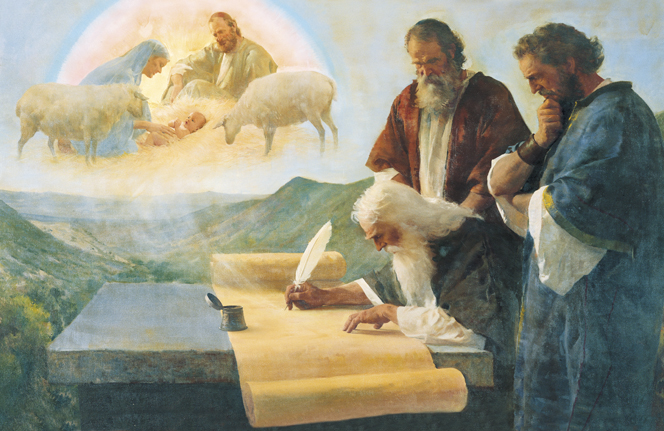
A painting of a prophet writing down his prophecy of Christ’s birth.
Peter Stoner, an emeritus professor of science at Westmont College, calculated the probability of someone fulfilling these prophecies. For example he took a liberal estimate of the number of people who have lived in Bethlehem since the time of Micah and divided it by a conservative estimate for how many people have lived on the earth since the time of Micah. This yielded the result that 1 in 300,000 people have been born in Bethlehem. After considering only eight prophecies, Stoner showed that only 1 in 10^17 (a 1 with 17 zeros after it) people will fulfill all eight of them. After considering 48 prophecies, Stoner showed that only 1 in 10^157 (a 1 with 157 zeros after it) people will fulfill all 48 of them. The American Scientific Affiliation confirmed the accuracy of Stoner's calculations.
 
To illustrate just how unlikely it is for someone to fulfill all 48 of these Messianic prophecies by chance, imagine that the entire universe was completely filled with an enormous number of pennies and one quarter. Now, imagine that all of these coins got mixed up, and you drew one coin from the universe at random. It is estimated that the universe has a volume of about 3.58 x 10^80 (358 with 78 zeros after it) cubic meters. Thus, it is far more likely for you to draw the one quarter from the universe than it is for someone to fulfill all 48 of these prophecies.
 
The math so far leaves us with only two reasonable possibilities: Either every single one of Jesus Christ's Apostles lied about the events that occurred in Jesus' life, or Jesus is the Messiah. Let us consider the likelihood that all of Jesus's Apostles lied about the events that occurred in Jesus' life.
 
In the Book of the Acts of the Apostles, we read about how the Apostles succeeded in getting many thousands of people to convert to Christianity. In Acts 2, we read that the Apostles had the Spirit poured out upon them on the day of Pentecost. They were able to speak to a large multitude of people from a variety of nations in their own tongues. Due to the Apostles' ability to speak in any language, the multitude became willing to listen. As Peter spoke, the multitude felt the Spirit, and three thousand people were baptized. In Acts 3, we read that Peter and John healed a man lame from birth. Due to this miracle, the congregation listened to what Peter had to say. My point is that there were many more people who had witnessed great works performed by Christ's power than just the Apostles.
 
File:Masaccio, polittico di pisa.jpg
 
The Early Christian Church suffered immense persecution. The Apostles spent much of their ministries in prison for not denouncing their stories about Christ. Peter was crucified upside down for sticking to his story. Thousands and thousands of early Christians suffered poverty, political abuse, murder, and/or being sold into slavery. All of this occurred because the Christians would not deny their testimonies before the Jews and Romans. They knew what they had seen, heard, and (most importantly) felt in their hearts. The likelihood that an individual will continue lying about his or her experiences in the face of tremendous persecution and/or death is low. The likelihood that many thousands of people will do so is astronomically low. Thus, mathematics can rule out lying as a legitimate explanation.
 
When we consider the math, we are left with only one reasonable explanation: Jesus is "the Christ, the Son of the living God (Matthew 16:16)." I can testify of this. My testimony is strengthened as I engage in scholarly research, but it primarily comes from an even surer source of knowledge, "my Father which is in heaven (Matthew 16:17)," I know from the Holy Spirit that Jesus is my Lord and my God, my Savior from my sins and sorrows. You can gain this witness too as you read, ponder, and pray about the Holy Scriptures. I say these things in the name of Jesus Christ. Amen.

Continued in The Math of Christ's Birth Part 3: The Wise Men and Star


Sunday, December 11, 2016

The Math of Christ's Birth Part 1: The Shepherds

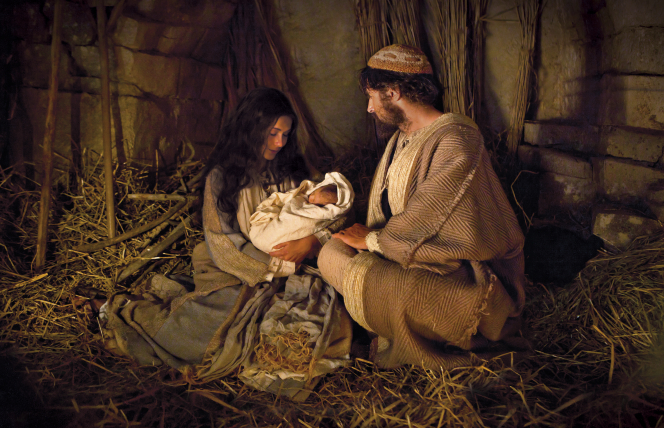
Luke 2:6–7, The holy family
 
Much of the world is acquainted with the timeless tale of Christ's birth. As the Bible teaches us, Joseph and the virgin Mary went to Bethlehem to be taxed. The time came for Mary to deliver the Christ child. There was no room for them in the inn, so Mary wrapped her baby in swaddling clothes and laid him in a manger. A new star appeared at the time of Christ's birth. Shepherds were visited by angels and told of the glorious birth of their long-awaited Messiah. Wise men came from the east to give gifts to the baby Jesus and worship Him.

Each Christmas season, hundreds of millions of people remember the birth of our Savior. However, far fewer people consider the mathematics relating to the Nativity story. This blog post (and ones that will be published later this month) are intended to help people learn more about the math of Christ's birth. In this blog post, I will consider the shepherds. In blog posts later this month, I plan to consider (from a mathematical perspective) the Messianic prophecies, the wise men from the East, the new star that appeared, and the commercialization of Christmas. I sincerely hope these blog posts will be thought-provoking and faith-promoting for all who read them.

Luke 2:6–7, Shepherds visit Christ
 
St. Luke recorded the following regarding Jesus' birth:
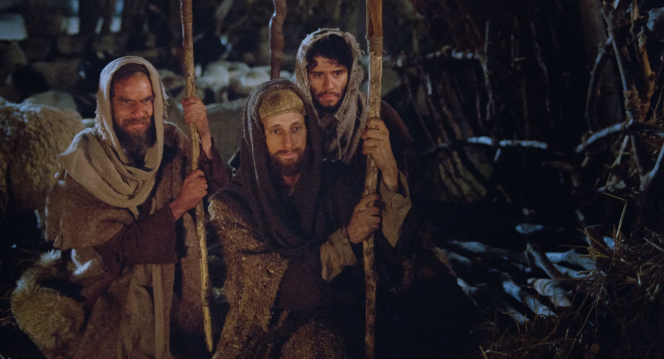
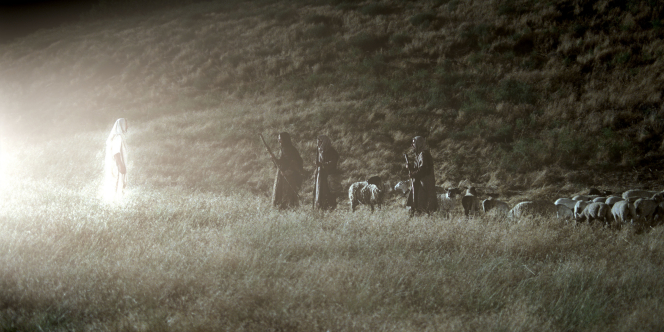
"And there were in the same country shepherds abiding in the field, keeping watch over their flock by night. And, lo, the angel of the Lord came upon them, and the glory of the Lord shone round about them: and they were sore afraid. And the angel said unto them, Fear not: for, behold, I bring you good tidings of great joy, which shall be to all people. For unto you is born this day in the city of David a Saviour, which is Christ the Lord. And this shall be a sign unto you; Ye shall find the babe wrapped in swaddling clothes, lying in a manger. And suddenly there was with the angel a multitude of the heavenly host praising God, and saying, Glory to God in the highest, and on earth peace, good will toward men. And it came to pass, as the angels were gone away from them into heaven, the shepherds said one to another, Let us now go even unto Bethlehem, and see this thing which is come to pass, which the Lord hath made known unto us. And they came with haste, and found Mary, and Joseph, and the babe lying in a manger (Holy Bible KJV, Luke 2:8-16)."
Up until the time that Joseph was sold into Egypt, shepherding was considered by the Hebrews to be a noble occupation. The Egyptians, however, considered shepherds to be the scum of the earth. By the time Moses led the Israelites out of Egypt, the Israelites possessed the Egyptian view of shepherds. When David, a shepherd, was anointed by Samuel, defeated Goliath, and became a powerful Israelite King, the Israelites' view toward shepherds improved. However, this did not last long. By the time Christ was born, shepherds belonged to Israel's lowest social status. The Jewish religious leaders had officially given shepherds the title of "sinners". (With this in mind, it is interesting to consider the fact that Christ referred to himself as a shepherd.)

From, a mathematical perspective, it is quite profound that Angels visited the shepherds. When Christ was born, an enormous number of people were less than 10 miles away. We read in Luke:
"And it came to pass in those days, that there went out a decree from Cæsar Augustus, that all the world should be taxed. (And this taxing was first made when Cyrenius was governor of Syria.) And all went to be taxed, every one into his own city. And Joseph also went up from Galilee, out of the city of Nazareth, into Judæa, unto the city of David, which is called Bethlehem; (because he was of the house and lineage of David) (Holy Bible KJV, Luke 2:1-4)."
There is also considerable evidence suggesting that Christ was born on 15 Nisan (See Note 1 to learn more). This would correspond to the Jewish Passover. Because people were gathering to be taxed and for the Passover, Jerusalem and its suburbs (including Bethlehem which is only 5 miles away from Jerusalem) would have been packed. This is why there was no room for Mary and Joseph in the inn. A famous Jewish historian, Josephus, wrote that approximately 1,197,000 people were gathered together in Jerusalem for the Passover in 70 A.D. (See Note 2 to learn more.) We can assume that a similar number of people were within walking distance of the Christ child when he was born.
 
Luke 2:8–15, Shepherds watch an angel approach

The Bible does not state how many shepherds were visited by angels. However, the text suggests that it was not a very large number. If we make the liberal guess that there were 30 shepherds who visited Christ the night of His birth, that is still only about 0.000025 percent of the people who could have visited Him that night. The angels visited an extremely small number of people at the very bottom of the culture's caste system!

Why did angels come to a small group of social outcasts? Why didn't they announce Christ's birth to the kings and priests? Why did Luke choose to record something about shepherds? We may never know all of the specific reasons during our earth life. However, there are clear lessons to be drawn from the shepherds; the numbers vividly show that God loves all of His children regardless of economic or social status. As St. John beautifully expressed:
"For God so loved the world, that he gave his only begotten Son, that whosoever believeth in him should not perish, but have everlasting life (Holy Bible KJV, John 3:16)."
 
 
Note 1: Nisan was the first month of the Hebrews' religious calendar and the seventh month of their political calendar. 15 Nisan corresponds to the beginning of April. Christmas is celebrated on December 25, but it is unlikely that Christ was actually born on that day. For example, the shepherds were spending their night outside. Most shepherds in Judea did not spend their nights outside with their flocks during the cold and rainy winter. Furthermore, the Romans typically did not have people gather to be taxed during the winter. Most scholars believe that early Christians picked December 25 for Christmas to correspond with the timing of Pagan festivals for the birth of the sun. Doctrine & Covenants 20:1 says, "The rise of the Church of Christ in these last days, being one thousand eight hundred and thirty years since the coming of our Lord and Savior Jesus Christ in the flesh, it being regularly organized and established agreeable to the laws of our country, by the will and commandments of God, in the fourth month, and on the sixth day of the month which is called April." Many LDS Church leaders and scholars have understood this verse to mean that Christ was born on April 6. Other Church leaders and scholars disagree. Regardless, 15 Nisan does happen to correspond well with Messianic prophecies and Jewish traditions regarding the Messiah.
 
Note 2: Josephus was born in Jerusalem, but later became a Roman. He was commissioned by the Roman Emperor to write a comprehensive history of the Jews. His writings are commonly quoted in Biblical commentaries. The Passover in 70 A.D. was when the Roman Emperor, Nero, destroyed Jerusalem. According to Josephus, most of the people who had gathered for the Passover were slain, and the rest were sold into slavery. That event (known as the Siege of Jerusalem) played a major role in the Apostasy of the Early Christian Church, but that's a different topic for a different blog post.
 
Feel free to comment with any questions you may have.