Sunday, October 9, 2016

By Small And Simple Numbers Part 1

Introduction

I have promised for the last couple blog posts that I would talk about the math behind some gospel relationships found in the scriptures. For those of you who have been anxiously awaiting the fulfillment of this promise, you're in luck; that's what this post is all about. However, I will first share a little background on this discovery.

One morning, I was studying the topic of knowledge and intelligence. I noticed an interesting pattern: the scriptures teach that if we increase our knowledge and intelligence, we will be able to continue to increase them at a faster rate. This can be compared to financial investment: the more money you currently have, the quicker you can gain more money.

Those of you who know me really well know that my two favorite things are the Gospel of Christ and math. Seeing a scriptural example of quantities changing in a specific way allowed me to recognize that my two favorite things can be combined. This was the birth of theometry. Within a few minutes, I was coming up with equations to model increases in knowledge and intelligence. Within a few more minutes, I was drawing graphs of the equations and showing them to my missionary companion. (I had been on a proselyting mission for the LDS Church for about six months at the time.) I was ecstatic.

Before long, I had come up with equations for knowledge and intelligence, faith and works, agency, diligence, et cetera. As I began to see the implications of these equations, the words of an ancient prophet named Alma kept coming to my mind. (I will explain why later in this blog post.)

By Small and Simple Things

Near the end of his mortal ministry, the great prophet Alma gathered together his sons Helaman, Shiblon, and Corianton to give them words of counsel. He spoke to Helaman first, and told him that he was going to entrust the spiritual and historical records of the Nephites and Jaredites into his hands. During Alma's explanation to his son of the great importance of these records, Alma said:
"behold I say unto you, that by small and simple things are great things brought to pass; and small means in many instances doth confound the wise. And the Lord God doth work by means to bring about his great and eternal purposes; and by very small means the Lord doth confound the wise and bringeth about the salvation of many souls."
Alma's words were surely fulfilled. Some of the recorded material given to Helaman later became part of what we know today as "The Book of  Mormon: Another Testament of Jesus Christ". This is a book of sacred scripture that members of the Church of Jesus Christ of Latter-day Saints (commonly referred to as "Mormons") read alongside the Holy Bible. From this book, millions of people around the world have gained a testimony of the gospel of Jesus Christ and a knowledge that God still speaks to His children today through a living prophet. This small and simple book has confounded the wise and brought about the salvation of many souls.


A painting by Tom Lovell depicting Moroni kneeling on a snow-covered hill and resting his clasped hands on the gold plates near a hole by a tree trunk.
Through small and simple miracles, records of ancient prophets were preserved and became the Book of Mormon.

The doctrine that God brings about immense results through very small means is applicable to so many aspects of Christ's gospel. I have gained a testimony of this as I have involved myself with theometry. The rest of this blog post will show a few gospel relationships that teach the impact of small and simple numbers. If you don't want to learn all the math involved, you can still learn from what I will share by reading the rest of the text and looking at the graphs.

Knowledge and Intelligence

Since I have already talked a little bit about knowledge and intelligence, we will investigate this gospel relationship first. We can easily learn how these two attributes are related by looking in a dictionary. The Google dictionary defines intelligence as "the ability to acquire and apply knowledge and skills." In other words, the greater your intelligence, the faster you can learn.

Intelligence = Rate at which you can increase your knowledge

We can learn even more about the relation between these attributes by reading the scriptures. Doctrine and Covenants 88:40 teaches:
"For intelligence cleaveth unto intelligence; wisdom receiveth wisdom; truth embraceth truth; virtue loveth virtue; light cleaveth unto light"
The more intelligence, wisdom, truth, or light we have, the faster we can improve at these attributes. Since we can gain knowledge faster by having more knowledge, and since intelligence is our ability to acquire knowledge, an increase in knowledge results in an increase in intelligence.

Increase in knowledge = Increase in intelligence

Now it's time for some math. I will represent knowledge with the letter "K", intelligence with the letter "I", amount of effort being put into studying with the letter "S", and time with the letter "t". For notation, I will have "∝" mean "is proportional to", and adding a "d" before a variable will mean "a change in". For example, if I said "dK ∝ 2", that would mean "a change in knowledge proportional to two".

In order for someone to have an increase in knowledge of a certain amount (dK), they need to have some level of intelligence (I), some amount of effort being put into studying (S), and some time to have elapsed (dt). A formula to model this concept is:
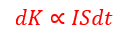
 
We can model the fact that an increase in knowledge naturally leads to an increase in intelligence with the equation:
 
Substituting this equation into the one preceding it, we get:


I will now use calculus to solve for "I" (It's okay if you don't know calculus. Feel free to skip down to the graph of the function I will derive.) I will assume the rate of study is constant over time and will introduce arbitrary constants (c1, c2, c3, c4, & c5):


Now, since a gain in knowledge yields a gain in intelligence, we can solve for "K"

 
Shown below is a graph of how knowledge or intelligence might change over time assuming a constant rate of studying:
 

Knowledge or Intelligence as a Function of Time as you study
Knowledge or Intelligence as a Function of Time

Why is mathematically modeling knowledge and intelligence useful? For me at least, visually seeing the enormous difference that putting forward the effort to gain knowledge can make is motivational. Seeing this graph helps me better understand my divine nature and scriptures such as Doctrine & Covenants 130:18-19:
"Whatever principle of intelligence we attain unto in this life, it will rise with us in the resurrection. And if a person gains more knowledge and intelligence in this life through his diligence and obedience than another, he will have so much the advantage in the world to come."
Increasing doctrinal understanding is crucial because, as Boyd K. Packer taught:
"True doctrine, understood, changes attitudes and behavior (Ensign, "Little Children")."
I can bear my testimony that God's hand is found in everything. As we seek for Him in all that we do, He will reveal Himself in ways we may not have expected. Stay tuned for my future blog posts!

"By Small and Simple Numbers" is to be continued.

Check out my other blog that gives Mormon answers for life's great questions at mormonanswersforlife.blogspot.com

Saturday, August 6, 2016

Constants - The Fingerprint of God

Constants, Fingerprint of God

God's Fingerprint is Everywhere
Every time I look at the world around us, I see a lot of parallels to the stories found in the Holy Scriptures. Today I was reading some Pew Research survey results on religious affiliation in the United States. It was devastating to see a staggering drop over the last decade in the number of people that identify themselves as Christians. Meanwhile, the number of people that claim to be atheist or agnostic has approximately doubled.

This reminds me of a scriptural story found in the Book of Mormon (a book of scripture used alongside with the Holy Bible) about a man named Korihor.
Korihor traveled throughout the land, preaching there is no God to the citizens of each city. He contended that "every man fared in this life according to the management of the creature; therefore every man prospered according to his genius, and that every man conquered according to his strength; and whatsoever a man did was no crime... [and] when a man was dead, that was the end thereof (Book of Mormon, Alma 30:17-18)."

Korihor ended up in a conversation with Alma, the leader of Christ's church in the land. Their dialogue went as follows:
"And now Korihor said unto Alma: If thou wilt show me a sign, that I may be convinced that there is a God, yea, show unto me that he hath power, and then will I be convinced of the truth of thy words. But Alma said unto him: Thou hast had signs enough; will ye tempt your God? Will ye say, Show unto me a sign, when ye have the testimony of all these thy brethren, and also all the holy prophets? The scriptures are laid before thee, yea, and all things denote there is a God; yea, even the earth, and all things that are upon the face of it, yea, and its motion, yea, and also all the planets which move in their regular form do witness that there is a Supreme Creator (Book of Mormon, Alma 30:43-44)."

Galaxy, Evidence of God

I have encountered many modern-day Korihors. Alma's counter-argument is full of wisdom. "All things denote there is a God." In this blog post I want to show how numerical constants denote there is a God. I will only discuss a few examples. I am sure there are many, many more valuable examples.

Phi
The first constant I want to talk about is called "Phi" (pronounced "fee"), is represented by the Greek letter "Φ", and is approximately 1.618. Phi is also commonly known as the "Golden Ratio". Personally, I think it should be called the "God Number" because it is an almost unparalleled evidence of God's hand at work.

Φ = 1.618...

Phi has a variety of cool mathematical properties. It is closely related to a mathematical series called the Fibonacci Sequence where each number is the sum of the two previous numbers.

Fibonacci Sequence:
1, 1, 2, 3, 5, 8, 13, 21, 34...


Phi can be approximated by taking any number in the Fibonacci sequence and dividing it by the previous number. The further along in the series you go, the closer the number is to Phi.

1 ÷ 1 = 1
2 ÷ 1 = 2
3 ÷ 2 = 1.5
5 ÷ 3 = 1.67
8 ÷ 5 = 1.6
13 ÷ 8 = 1.625
21 ÷ 13 = 1.615
34 ÷ 21 = 1.619
 

Here is a another fascinating relationship between Phi and the Fibonacci sequence (The Fibonacci sequence is found going downwards in both of the columns of blue numbers):

 Φ^1 = 1 × Φ + 0
Φ^2 = 1 × Φ + 1
Φ^3 = 2 × Φ + 1
Φ^4 = 3 × Φ + 2
Φ^5 = 5 × Φ + 3
Φ^6 = 8 × Φ + 5
Φ^7 = 13 × Φ + 8
Φ^8 = 21 × Φ +13

In addition to creating these (and many more) cool math relationships that are clearly not coincidence, Phi is found all throughout nature. It is found in ratios between many parts of the human body, honey bee breeding habits, planetary orbits, and the spirals of DNA, sunflowers, pineapples, snail shells, etc.
Below is a drawing of a Nautilus shell with vertical and horizontal lines following the spiral. If you start at the center of the spiral and work your way outwards, each straight line increases in length by a ratio of Phi:
Nautilus, Fibonacci Sequence, Phi
 
How amazing is that? Phi is found everywhere in mathematics and nature. Science offers no explanation for why this constant keeps popping up in so many seemingly unrelated things. However, if all things were made by a Divine Creator, then an explanation is clear; Phi is part of the fingerprint of God.

The Speed of Light
Another constant that is a powerful manifestation of God's fingerprint is the speed of light. The speed of light is represented by the letter "c" and is 299,792,458 meters per second. (That is just over 670 million miles per hour!)


c = 299,792,458 m/s

In the early 1900's Albert Einstein came forth with his groundbreaking theory of Special Relativity. He proposed the radical idea that matter and energy can be converted back and forth into each other. (This has since been demonstrated very clearly with the atomic bomb.) For this conversion, he put forward his most famous equation:

E=mc^2
 
Energy equals mass (similar to weight) times the speed of light squared. The idea that the speed of light determines how much energy you get for a certain amount of mass is truly amazing! The speed of light is such an arbitrary value, yet it is the same constant used for this and many other important equations in physics about things other than light. Why is this? Once again, God's hand is at work.
 
Another thing that shows the speed of light is a value determined by God is merely the fact that it is a constant. Why does light travel at the same speed in every part of the universe at all times? If this universe was created by chance as many people claim, wouldn't we expect the speed of light to have been randomly determined? If it was randomly determined, why doesn't light change speeds at random as it moves from place to place? Science does not provide any explanation for how constants are determined and enforced throughout all space and time. On the other hand, revealed religion does.

A revelation from God to one of His modern-day prophets teaches that something called the Light of Christ "proceedeth forth from the presence of God to fill the immensity of space. [It's] the light which is in all things, which giveth life to all things, which is the law by which all things are governed, even the power of God who sitteth upon his throne, who is in the bosom of eternity, who is in the midst of all things (Doctrine and Covenants 88:12-13)." The Light of Christ is the mechanism by which God implements constants throughout all space and time.
 
Pi
The final constant I want to talk about is Pi. Pi is represented by the Greek letter "π" and is approximately 3.14.
 
π = 3.14...
 
 Pi is defined as the ratio between the circumference and diameter of a circle.
 
Circumference, Diameter, Pi
 
The amazing thing about Pi is the fact that it never changes; the circumference of a circle divided by the diameter always equals 3.14... Some might ask "Why is that so incredible? Isn't it obvious that the circumference and diameter always maintain the same ratio?" However the issue is actually not that simple.

Einstein's General Theory of Relativity, which has been consistent with observed data up to this point, posits that space is not flat but curved. It is true that we can't see this curvature, but, according to Einstein, we can feel it. Einstein's theory says that gravity is the result of spacetime being curved. Once we accept that space can be curved, Pi being a constant is truly a miracle.
 
To demonstrate this, imagine that a circle is drawn on a flat surface. The ratio between the circumference and diameter will be about 3.14.
 
3D Flat Furface
 
Now imagine that a circle with the same circumference is drawn on a spherical surface. If we measure the distance from one side of the circle to the other, traveling along the surface of the sphere, we will get a larger number than we did on the flat surface. Since the diameter is longer than before, the ratio between the circumference and diameter will be less than 3.14. We can see that the value for Pi changed.

3D Spherical Surface
 
Finally, imagine that a circle with the same diameter as the circle on the flat surface is drawn on a saddle-shaped surface. If we measure the perimeter of the circle, traveling along the saddle, we will get a larger number than we did on the flat surface. Since the circumference is longer, the ratio between the circumference and diameter will be greater than 3.14. Once again, we can see that the value for Pi changed.
 
3D Standard Saddle Surface
 
The physics equations for spatial curvature state that the density of mass in a region of space determine its shape. If the universe really did spontaneously create itself in a Big Bang (as so many people claim,) we could expect to see a random mass distribution throughout the universe. Consequently, space would be curved like crazy all over the place with no apparent pattern. It would therefore not be unreasonable to expect to see Pi varying at different locations. However, we don't see this. Rather, there appears to be a definite order and uniformity to all things throughout the universe.

Again, math allows us to see Divine Providence in action. Apart from spiritual impressions, what better testimony-builder is there than theometry? Perhaps there is none. Check back in a couple weeks to see my next blog post on mathematical relationships in the scriptures.

Check out my other blog that gives answers to some of life's great questions at mormonanswersforlife.blogspot.com/

Monday, July 25, 2016

What in the World is Theometry?!


Theometry's Story
I grew up learning that math existed on one side of an imaginary fence and religion was on the other. I honestly thought of them as distinct subjects that were completely separate from each other and were not to be mixed. I knew they didn't contradict and were both useful to know. In fact, I felt strongly that they filled in each other's gaps. Yet, I never once thought during calculus class, "Wow, I wonder how this relates to God!" Nor did I ever think in Sunday School, "I wonder what Christ's Atonement can teach me about mathematics."
 
Equations on a white board, a black iron fence, and Jesus Christ hanging on the cross at His Crucifixion
 
Not too long ago, I was serving a proselytizing mission for the Church of Jesus Christ of Latter-day Saints (commonly nicknamed "the Mormons".) During my mission, I came to a stunning realization: God is a God of math! My lifelong mental separation of math and religion was merely a lack of understanding! I am quite the math nerd, and I am especially fond of mathematical modeling. (Mathematical modeling is making equations that describe real-life phenomena.) So, I quickly got to work making equations that describe gospel principles. I got a couple friends to help out. Since I had just discovered a new branch of mathematics, I just had to give it a classy name. After months of spinning the gears in my head, the perfect name came to me: THEOMETRY. "Theos" is Greek for god, and "-metry" is a Greek-derived suffix that means "to measure". Thus, "theometry" would be defined as the branch of mathematics that deals with measuring the things of God. (Not to mention, there is just a special ring about the word! It sounds like a mix between the words geometry and theology.)

A graph of a math equation overlayed with Jesus Christ.

I am learning so much great stuff from theometry, so I have wanted to share it with the world for over a year. A few nights ago, I had the brilliant idea of giving theometry its very own blog. I just know this blog is going to be revolutionary, so be sure to become a blog follower.

What in the World is Theometry?
I know your curiosity is now peaked. What in the world is theometry?! How do math and God go together? Is God really a God of math?
Theometry is everywhere. There are many different ways that math and God relate. To see what I mean, let's take a look at the holy scriptures.
The scriptures are packed full of relationships between different things. An equation is defined as a relationship between 2 or more things. Therefore, every time a relationship is established, it can be described with a math equation. Since religion and math are being blended, these equations fall under the scope of theometry.
As a simple example, the Book of Mormon (a book of LDS scripture that goes alongside the Holy Bible) states:
"Wherefore, men are free according to the flesh; and all things are given them which are expedient unto man. And they are free to choose liberty and eternal life, through the great Mediator of all men, or to choose captivity and death, according to the captivity and power of the devil (2 Nephi 2:27)."
This verse teaches that we have the freedom to make choices. If we use our freedom wisely, our freedom will increase. Otherwise, our freedom will decrease. There is a clear relationship between our choices and our freedom. Thus, there must be an equation to describe how our choices and freedom relate. (In a later post, I will discuss the actual math behind this verse, but for now I just want to demonstrate that it contains math.)
Statement showing that our change in moral agency is proportional to the quality of our decisions.
I have figured out equations that model a significant number of gospel relationships. As I have done so, my testimony of the gospel's self-consistency and interrelatedness has grown significantly. More importantly, I have gained a greater understanding of how the gospel works. As I have made graphs for equations I have developed, I have been able to visually see the long-term effects of short-term choices. Viewing these results has drastically increased my drive to improve my actions. I have seen first-hand just how much good theometry can bring about.
Modeling gospel relationships is only the tip of the iceberg. As will be discussed in future blog posts, math can be used to analyze the scriptures' and modern-day prophets' literary structures, self-consistency, progression of civilizations, name derivations, and so on. Looking at scriptural writings from a mathematical perspective enables us to test their plausibility. Math can be used to determine the likelihood that life on this planet occurred by chance rather than having been created intentionally by a Divine Power. The possibilities are truly endless.

Is Theometry of the Devil?
As I have worked to develop theometry and have told some of my close friends about it, I have met a lot of resistance. As an example, one person told me that theometry is in complete opposition to the will of God. He argued that God wants us to live according to faith, not according to mathematical formulas. He further contended that it is a sin to try and measure God.
Is theometry really a sin? I do not believe it is. The scriptures teach us that "God created all things (Book of Mormon, Mosiah 4:9)." If this is true, did not God create math? The scriptures also teach that "all things...are made for the benefit and the use of man (Doctrine and Covenants 59:18)." We must conclude that God made math for our use and benefit. Any time that math is used to solve a real-world problem, one or more of God's creations are being measured. So, in a sense, one is measuring the things of God. If theometry really was a sin, then no math should be engaged in. However, as I already showed, God made math for our use and benefit. Furthermore, the scriptures teach that "all things which are good cometh of God (Book of Mormon, Moroni 7:12)." Engaging in theometry has done nothing but build my faith (contrary to what my one friend said would happen.) Is it not then of God?

Jehovah Creates the Earth by Walter Rane overlayed with an equation.

Many incorrectly think that faith is completely blind. That notion is completely contrary to the Lord's teachings on faith found in Alma 32 and Hebrews 11. Yes, we need to take a step into the darkness, trusting that the Lord will take care of us if we follow Him. But, where does this trust come from? We gain the trust to follow God from the evidences we have seen up to that point. Faith is evidence-based belief that motivates us to act even when it is difficult. Therefore, seeing mathematical support for God will increase our faith if we are yielding our heart unto Him.

Stay Tuned
As I previously stated, I know this blog's future content will cause a paradigm shift. No reader of it will ever think about math and religion in the same way again. So, I am once again petitioning you to become a blog follower.

Be sure to check out my other blog that gives answers to life's tough questions at mormonanswersforlife.blogspot.com